It was lovely to chat with my friends and colleagues from Positive Psychology coaches Ireland, to discuss our career transitions. Exploring our shared love of learning, chatting about living a life that is aligned with values and finding ones niche are explored.
Diversity at Work
It was a pleasure to join Una Buckley and colleagues to discuss the importance of Belonging in the workplace. Believing that you belong and that your work and contributions matter is hugely important for both motivation and emotional wellbeing.
Communicating Effectively with Schools
Earlier this year I did a podcast with Una Buckley from Blossom4life about how to communicate effectively with schools. Lots of useful tips on how to build a colloborative working relationship with teachers. Working in partnership with a school is a vital part of supporting your child’s learning in school particularly if they are getting additional supports. Advocating for your child is an important role and it can take time be build the skills.
After the Parent/Teacher meeting, what will I do now? Tips for following up school concerns
As the school year draws to a close, many homes will receive the end of year report about their child’s progress in school. Some will also receive a phone call or even be invited to a meeting to discuss school concerns. You may have been advised to get an assessment for your child. Alternatively, you may have had a nagging feeling all year that your child is not progressing as well as he/she should and when you see the report, you realise that you want to explore this concern further.
Step 1: Getting an assessment
You have two choices in most cases, that is public or private. Unfortunately, in both sectors waiting lists are very long. If going downt the private route, make sure that the professional you are hiring is registered with their professional body, this is vital. Speech therapists and Occupational therapists are CORU registered but unfortunately many other professionals are not, for example psychologists are not CORU registered. Chartered psychologist is the highest membership grade of both British Psychological Society (Bps) and Psychology Society of Ireland (Psi) and most psychologists in Ireland especially those in private practice will be a member of either the BPS or PSI. You can check the PSI directory of Chartered Psychologists here
https://www.psychologicalsociety.ie/about/PSI-Chartered-Psychologist-Online-Directory
In any case, if you have any questions or want reassurance about credentials, please do ask. Professionals should have no problem answering your questions clearly.
Remember also although waiting lists are very long, if you can be flexible about last minute appointments, make sure to say this and they may put you on a cancellation list.
Step 2: Getting a Report
After an assessment you will receive a report about your child. This report would typically contain a detailed summary of all the information gathered during the assessment process, the conclusions that the clinician came to as a result of examining this information and a list of recommendations. In my experience three outcomes are the most common in reports;
- Clear diagnosis and list of recommended strategies for school and home
- No diagnosis and a list of recommended strategies for school and home
- No diagnosis, a list of strategies and suggestion for onward referral.
No Diagnosis Now what? As you can see, no diagnosis can be a common, albeit frustrating result and sometimes parents are worried that this means their child will not get support. It is really important to remember that in a mainstream school setting there is very little practical difference between options 1 and 2 in terms of support provided by school. Since 2017, schools do not allocate resources based on diagnosis but rather on what is called ‘identified need’, so you do not need a diagnosis to access support in a mainstream school. Diagnosis is usually needed to access specialist supports such as special class or when applying to 3rd level using DARE. Often a report will also suggest that you take your child for another assessment, such as Speech and Language assessment or Occupational Therapy assessment. This is very common. Each clinician can only work within their own areas of expertise, but often concerns about the possibility of something else outside their expertise is noticed during the assessment process. For example, it is very common for children struggling with literacy to have either dyslexia or a language delay, but finding out which can mean two different assessments.
What should I do now? As a parent you may feel frustrated that your child’s need does not fall into a clearly identifiable box, and that is very understandable. The criteria for diagnosis are very clear and not everyone will meet that threshold. Let’s use the analogy of a dysfunctional ankle. If someone has a non-functioning ankle that is clearly identifiable as a diagnosis of disability and they may need lifelong support. If someone has a broken or twisted ankle, that is clearly identifiable as a need but a temporary need. If someone has a weak ankle, they may need to wear good boots to support their ankle. As you can see the same area of need, gets support, just different levels of support.
Does the school have to do everything on the report: Resources are limited in almost every service. Clinicians write recommendations based on the best interests of the child and based on the data gathered during the assessment process. Unfortunately, schools and services may not have the resources to follow up. So practically speaking try to get some feedback from the clinician and choose the top three actions that must be done, this is something I do in my own practice. I often help parents make sense of professional reports as they can be overwhelming. Recommendations are just that, recommendations, they are not list of things a school is obliged to do. Schools should (and usually try to) do their best to enable a child to access the curriculum to the best of their ability. I find it can be really helpful to arrange a meeting with the school and discuss the report, how can the needs of your child be met in the context of the overall school resources, how can you support the school to get more resources? Can you lobby the SENO/NCSE/Local Politician, Can you ask the clinician to rephrase a recommendation?
The report is often only the starting point, it is useful for pointing you in the right direction.
In my experience that vast majority of schools will do the best they can with what they have but they are concerned about hundreds of children you are concerned about one and in that disconnect some difficulties can arise. It is really important that both parties communicate clearly, with courtesy, with consideration and compassion. In my own practice I often support parents by coaching them around advocacy skills and managing school meetings and taking some time to plan your approach can be really helpful.
Step 3: Do I have to repeat assessments? Not always but all reports have a shelf life. An in-date report is usually needed for 3rd Level. Sometimes schools will request an updated report, it may be useful to ask them for the reasons why and what resources are dependent on an up-to-date report. Reports are expensive and can’t be repeated too often so make sure that if you are paying for a review or updated report that it is really necessary. However, it is also important to remember that the reason reports have a shelf life is that the information changes. Your child has grown, changed, received supports or not, so a fresh baseline of information can be very helpful.
Who does what?
- NCSE – National Council Special Education. This service is responsible for funding related to special education, including special classes, SNA’s, assistive technology and school transport amongst other things.
- SENO’s- Special Educational Needs Officer, works for NCSE and is assigned to a geographical area to process applications, liaise between schools and the Dept.
- VTS- Visiting Teacher Service, now part of the NCSE, these are specialist teachers for Hearing impaired and visually impaired
- SLT- Speech and Language therapist (look for CORU registered)
- OT- Occupational therapist (look for CORU registered)
- Psychologist- currently not a protected title so look for Chartered membership of either BPS or PSI
- SET- Special Education Teacher or SET hours special education teaching hours. The terms learning support and resource are no longer used
- SENCO- Special educational needs co-ordinator- the teacher assigned to manage the allocation of SET hours in a school
- GLD- General Learning Difficulties, commonly refers to mild, moderate or severe intellectual disability
- SLD- Specific Learning Difficulty, commonly refers to dyslexia, dysgraphia, dyscalculia etc.
- IEP- an individual education plan which outlines the details about the additional support a child will receive, also called SSP student support plan, or SSF student support file
- DARE and RACE- when your child reaches post primary, they will have to complete state exams and may apply to 3rd level. The SENCO will advise you about applying for reasonable accommodations for exams and the disability access route to 3rd level.
Returning to routine: ACTIONs for wellbeing
Workplace wellbeing is critically important in a post pandemic world and there is a growing body of research about the changes in the workplace linked to Covid-19. At an organisational level, employers can do a lot to ensure psychological safety and at an individual level, employees can take steps to enhance their wellbeing and build a life of with pleasure, meaning and engagement.
Learning from the pandemic rollercoaster
Working through a global pandemic was a rollercoaster of emotions and experiences both good and bad. You may have developed some positive habits that you want to maintain in a post pandemic world, or you may be looking forward to connecting socially with your colleagues.
How do you decide what habits to keep and what habits to ditch?
Draw your own personal roller coaster/timeline of the past two years. Consider your physical, emotional, psychological and spiritual wellbeing. In order to craft a new way forward, it is critical to build on a foundation of what we know already works. What worked for you in the last two years? During the dips in your timeline, what strengths did you draw on to navigate those challenges? What was necessary to survive those first few months working from home and what is necessary to thrive going forward?
One way to assess the effectiveness of your daily habits and practices for supporting your wellbeing is to look at the ACTIONS model (Boniwell, 2017). Positive psychology activities are activities that support and cultivate positive feelings, behaviours and thinking. The ACTIONS are;
Active habits: Physical activities such as yoga, walking, dance, swimming etc;
Calming activities: This includes calming and soothing exercises such as mindfulness, savouring, breathing exercises and meditation
Thinking activities: These types of activities include journaling, gratitude diary and growth mindset exercises and positive thinking
Identity activities: Develop self-awareness through creating a Strengths portfolio, best possible self-exercise and job crafting
Optimising activities- These activities orientate to optimising behaviours and actions through SMART goal setting, Hopeful thinking and setting boundaries
Nourishing interventions- This area places the emphasis on good sleep habits, self-care through nutrition and exercise, engaging with nature and practicing self-compassion
Social activities- The value of social connections, developing high quality social networks, sharing positive experiences and practising empathy.
Which good habits do you want to maintain in your post pandemic life?
Current psychological research has consistently found that social connections, being active and regular practice of gratitude are well evidenced paths to improved wellbeing. Being part of multiple social groups can provide social support and has an extensive range of positive effects, it is protective against stress, it improves physical health and reduces depression, How can you ensure that your daily life includes some social connections? Strong social connections in the workplace has been linked to less stress and greater productivity.
Positive ACTIONS to support your wellbeing this spring;
- Active – 30 minutes exercise each day or 3 x10 short walks outside in nature. Plan your daily exercise plan in advance, can you fit in 15 minutes at lunch time? Throw some runners in the boot of the car just in case an opportunity to get some fresh air arises.
- Calming – Savouring is the practice of giving your full attention to the current moment or activity. It is far too easy to mindlessly swallow breakfast or rush to the next meeting. Savouring requires us to take a moment of mindfulness and be fully present. You can focus by memory building, take a mental photograph of the event to think about later, focus on your senses, what can you hear, see, smell, touch?
- Thinking activities: Three good things is a well evidenced way to build up your ‘positivity muscles’. Each day take some time to think or write about three good things that happened that day. Reflect on what went well today. Did someone let you out at a busy junction? Did the meeting finish early? Did a colleague acknowledge your work?
- Identity activities: What are your strengths and how can you use them more in your daily life? If your strength is creativity, could you make a nutritious lunch from new ingredients? Can you lean into your strength of social intelligence and organise a group walk at lunchtime? Setting an intention to use your signature strengths in a new way is a strong and research proven activity. You can connect strengths to moments of happiness and flow, can you think of a situation the last few weeks where you were engaged and absorbed in the task. What strengths were you using in that situation?
- Optimising activities- What boundaries are important for you as you return to the workplace and how will you maintain them? Positive visualisation is a useful method to envisage a more fulfilling life. Taking a few moments to actively think about various futures, what would it look like or sound like? In what way would daily life be different? is a very effective technique for ‘trying on’ various paths. Once you have chosen your path, then the work of goal setting can begin.
- Nourishing interventions- Our physical state plays a major part in our psychological wellbeing. A good night’s sleep is critical for wellbeing. Set consistent waking and sleeping times. Dim your lights and minimise exposure to blue light from phones or laptops before bedtime. As the summer days get longer, it may be time to invest in black out curtains or blinds.
- Social activities- Creating relationships and connecting with people in your life is a well evidenced way to enrich your life. Mixing with likeminded individuals over a shared interest is one strategy and social media can be very helpful for identifying online support groups and special interest groups even if there are not the numbers in your local area for a club or group.
If you want to learn more about how to apply any of these ACTIONS to your life, get in touch for a bespoke programme to support you on your path to a flourishing and fulfilling life.
A version of this blog first appeared on http://www.positivepsychologycoaches.ie
Cultivating Connections: Reframing conversations to be solution focused rather than problem focused.
February 2022
“Problem talk creates problems – Solution talk creates solutions“
(Steve de Shazer)
A central idea in positive psychology is to focus on what is going well in our current lives and do more of that. Solution focused conversations help people to explore their strengths and resources rather than focus on their problems and deficits. Solution focused approaches developed from the field of family therapy in the 1980S (de Shazer & Berg). Exception finding is a core theme in solution focused conversations. The solution focused approach takes the position that all problems have exceptions. There are times when the problem is less evident or not a problem. Solution focused conversations are rooted in the present and plan for the future. Solution focused questions can support individuals to notice the things in their lives that are going well and notice if part of their goal is already happening. When working with my clients, I use solution focused questions to support young people explore the strengths they have in the present and focus on their future goals. Many young people can feel powerless in the face of problems with school or friendships and solution focused questions can move their attention from being problem focused to solution focused and building on what is already working.
I have outlined some of the core techniques used in solution focused conversations below and provided some useful reading if you are interested in learning more about this approach. This is a very brief introduction to some of the techniques of this evidence-based strategy that is effective in many settings and across many age groups.
Strength spotting is a simple, accessible and highly effective introduction to becoming solution focused. Engage in conversation about things not directly connected to the problem or challenge. Actively listen to stories about school, college, sports etc. and intentionally focus on noticing evidence of competencies and strengths. Bring their strengths to their attention and amplify their successes. For example, turning up on time regularly to football training suggests commitment, punctuality and team work. Taking care of pets, looking after younger siblings can be highlighted as evidence of kindness, nurturing and responsibility. Using problem free talk frames, the young person as a capable and resourceful person.
Miracle Question, there are many variations on the Miracle question and all centre on the idea that in getting a person to identify their ideal future, they are expressing the direction for their preferred future. Allow the person to describe in detail their miracle day/miracle future gives them the space the describe their world without problems. This is valuable information for supporting a person when goal setting. An example of the miracle question is “Suppose there was a miracle during the night when you’re asleep, and the problem disappeared overnight, how would you know when you woke up? What would be different in you?
Goal setting, leads naturally from the miracle question and this is where the young person identifies the skill that needs to be learnt, the action to be take etc. in order to resolve the issue. When developing the conversation towards goal setting it is useful to use language that implies a positive outcome such as; How will you do that…? When this happens…?. Focus the conversation on what is wanted rather than what is not wanted.
Scaling is a flexible technique that can be used to help a person identify movement towards their goal. It is especially helpful when the person is struggling to identify goals or exceptions to their problem. Progress on the scale can be small. Using visuals of ladders, mountains, steps etc. can be very effective and the question is simple- On a scale of 0 to 10, where 0 is the worst you can imagine and 10 is fine Where are you this week?’ So if the person is at a 4, why are not at 3, what strengths are they using to be at 4, what strengths could they use to be at a 5?
Examples of useful solution focused questions
If you could wave a magic wand and the problem disappeared what would life be like?
What would be the first signs that a miracle had happened?
What did you do that made that happen?
What helped you to be able to do that?
How will you know you have achieved xx?
What will you be doing when you have ???
Useful Resources
This toolkit from NSPCC is very useful and practical and ideally suited for working with young people
This blog from Brief outlines the connection between solution focused approaches and research from the field of positive psychology, in particular the powerful impact of eliciting positive emotions.
Rae Tina, Thomas Miles & Walshe J (2018) The essential guide to using solution focused brief therapy with children and young people
Iveson, Chris, George, Evan & Ratner (2012) Brief Coaching: A solution focused approach
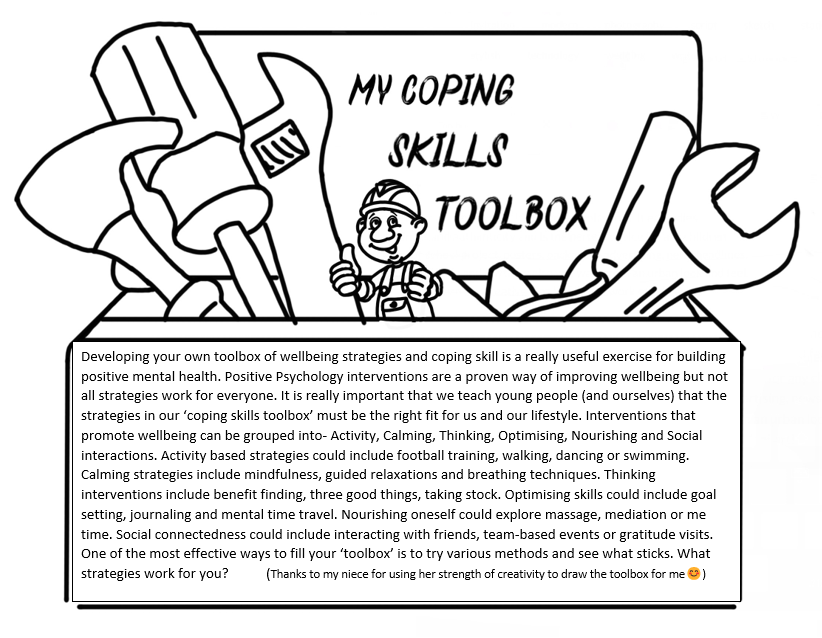
Support Wellbeing by creating a coping skills toolbox
Helpful tips for parents concerned about their child’s progress in school
Podcast for Cork Children’s Clinic 2021 6/12/21 The Happy Baby podcast
I was delighted to collaborate with Cork Children’s Clinic for their inaugural podcast series- The Happy baby and child, see @thehappybabypodcast, @corkchildrensclinic http://www.corkchildrensclinic.com
The focus of the podcast was to give parents some tips to make the most effective use of time with professionals (Teachers and Clinicians) when discussing their child.
- What is your concern?
- Is it academic or emotional?
- Why is this a concern now, what has changed?
- What do you want to know that you don’t already know?
- Does your child share your concerns?
- Collaboration with schools
- A clear, courteous and collaborative working relationships is vital, you will be working together to support your child for many years
- Follow the school policy for arranging teacher meetings
- Plan for the meeting, set out an agenda, bring a notebook
- Take notes and double check that you have understood all the ‘jargon’
- How can I find out what a school is supposed to do?
- The Dept of Education issues guidelines to schools in the form of ‘circular’s, these are numbered by number/year e.g., 14/17, these are the instructions that the schools have to follow, see links below
- Schools are operated by Boards of Management and must follow their own policies. Do you know the relevant policies in your child’s school?
- I think my child is entitled to hours?
- The allocation of additional support hours to students based on their needs was changed significantly in 2017. Since that date the allocation of extra support is on the basis of ‘identified need’ and not necessarily a diagnosis, (* this is in mainstream settings only). Thus, children are currently not automatically granted support based on a diagnosis but rather on the availability of resources in the school in any given year. This was designed to be a more equitable approach, eliminating the need for parents to fund expensive private assessments. In practice schools are grossly underfunded and thus allocation of support or ‘hours’ can be difficult.
- Who does what?
- NCSE – National Council Special Education. This service is responsible for funding related to special education, including special classes, SNA’s, assistive technology and school transport amongst other things.
- SENO’s- Special Educational Needs Officer, works for NCSE and is assigned to a geographical area to process applications, liaise between schools and the Dept.
- VTS- Visiting Teacher Service, now part of the NCSE, these are specialist teachers for Hearing impaired and visually impaired
- SLT- Speech and Language therapist (look for CORU registered)
- OT- Occupational therapist (look for CORU registered)
- Psychologist- currently not a protected title so look for Chartered membership of either BPS or PSI
- SET- Special Education Teacher or SET hours special education teaching hours. The terms learning support and resource are no longer used
- SENCO- Special educational needs co-ordinator- the teacher assigned to manage the allocation of SET hours in a school
- GLD- General Learning Difficulties, commonly refers to mild, moderate or severe intellectual disability
- SLD- Specific Learning Difficulty, commonly refers to dyslexia, dysgraphia, dyscalculia etc.
- IEP- an individual education plan which outlines the details about the additional support a child will receive, also called SSP student support plan, or SSF student support file
- DARE and RACE- when your child reaches post primary, they will have to complete state exams and may apply to 3rd level. The SENCO will advise you about applying for reasonable accommodations for exams and the disability access route to 3rd level.
- What is the most important thing I can do now?
- Get a notebook. Put your childs name on it. This is where you write your concerns, your observations, your notes to yourself to check something out. This is where you put the name of the person you are speaking to on the phone, this is where you plan for your meetings and take notes during meetings
- Know that most professionals you encounter are trying their best in an underfunded system, don’t shoot the messenger
- Know that you are trying your best
Useful websites
https://www.hse.ie/eng/services/list/4/disability/disability-assessment/
https://www.psychologicalsociety.ie/footer/PSI-Chartered-Psychologist-Online-Directory
Anxiety and Return to school and Routine
October 2021
One month into the new school year and families and children have slipped back into routine with gratitude and some nerves. Many children and young people will have experienced Covid specific losses to their family unit in the last 18 months such as bereavement or unemployment. Most young people have missed play, socialization, rites of passage, routines as well as opportunities to build relationships with trusted adults. Some anxiety and uncertainty are to be expected in the coming months and it will be important for the adults in their lives to model self-care and allow space for ‘big’ and not so big feelings to be expressed safely. Children have demonstrated flexibility, resilience and compassion for others and it is important that we acknowledge and affirm this in addition to providing supports for them to express frustration and grief.
So how can we support children and young people in a post pandemic world? I like to summarize my approach with 3 C’s, connect, communicate and compassion.
Connect Communicate Compassion
- Connections are crucial. Relationships provide vital emotional connections for children which buffer against stress and anxiety. Take time to nurture relationships in your family. Make sure that your family schedule as time for exercise, play and free time and quality time together. Use a visual schedule, if necessary, see www.ncse.ie for some great ideas on how to use visual schedules
- Communicate clearly and consistently by explaining expectations, setting boundaries and creating routines
- Develop a Sunday evening plan to support young people prepare for the week ahead. This could include going over the routine for the coming week, reminding them what is scheduled and writing them on a calendar. Take time to calm any fears by providing a safe space for worries to be discussed. Focus on the positive- What three good things happened this weekend?
- Some children will have difficulty ‘changing the channel’ and find it hard to move past anxious thoughts. Respond with compassion. Consider setting aside some ‘worry time’. Worry Time should last about 15 minutes. Sit your child during Worry Time to listen to the worries they have. This should be a peaceful time so no TV, no phones, no interruption from the rest of the family for any reason. Drawing or writing worries during this time can help and putting them in a Worry box can also help. Develop emotional literacy by supporting children to name their feelings. Naming how they feel makes it easier to deal with the feelings, this ‘name it to tame it’ approach is highly effective.
- Time in nature and physical activity have a strong evidence base for decreasing stress levels- get out for a walk, throw a ball or do a listening walk. A listening walk is a great activity to teach mindfulness in nature. Have the children go outside to a garden or a wood. Listen carefully to every sound, what you can you hear? Is it a bird? A dog? A person? Can you identify it? How many sounds can you hear?
- Outdoor activities to promote wellbeing with younger children- Play with them, get some chalk and draw silly faces on the patio, teach them hopscotch, chalk a ‘road’ or ‘train track’s, take a few minutes out of your door to connect with them
- Communicate with compassion and talk so that your children will listen.
- Choose your time carefully. Are they well rested and fed? Are they distracted? Would a short car journey be a good time to have a chat?
- Use a soft tone of voice and explain your point of view carefully and clearly.
- Clarity of intent, make sure that you lead with your intention is to support and protect your child’s wellbeing and safety.
- Repetition- Let a few days pass between conversations to allow the young person time to digest and reflect on the ideas presented
- Teach children basic relaxation strategies, these moments are great for connecting with young people. Model self-care and self-regulation activities so that the practice of self-care becomes normalised in your home.
- Practice the Pause, take a deep breath, pause, center yourself and then respond
- Think compassion and connection- focus on remembering or bringing to mind positive memories or successful experience. Reflect on the positive qualities of that memory and how it makes you feel. This shift in thinking can balance out the feelings of anxiety
- Practice blowing bubbles, bubbles are great for teaching children to control their breathing and also great fun
- Squish Squash Squeeze- this progressive relaxation activity is very simple. Ask children to lie down with eyes closed. Ask them to squish or squeeze every muscle in their body then release. You can guide them by starting them at toes and working in up and you can help younger children by providing a squash with a cushion etc.
- Be curious about their day. Ask open ended questions such as ‘what good thing happened today? Who came to visit your class today? Remember it is important to listen to their stories now because even if it seems like small stuff to you, it is big stuff to them.
It is normal to experience feelings of anxiety and it is important that young people feel validated and heard when they express these feelings. Responding with compassion is important. It helps if you can educate yourself about anxiety. Anxiety is normal. It is the brains way of coping with danger. Anxiety becomes a problem if it is interfering with daily living. The link below is an accessible and child friendly explanation of how the brain works when experiencing anxiety.
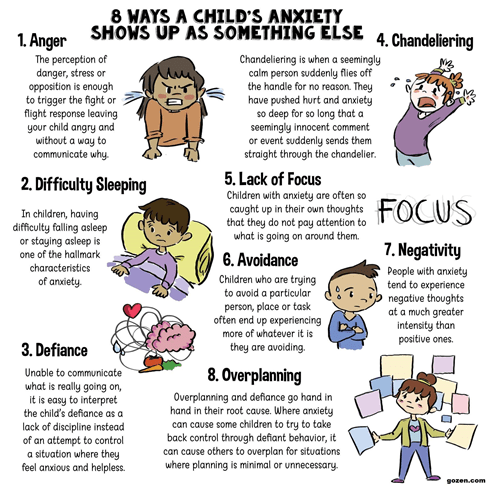
Anxiety does not always show up as appearing worried. This excellent infographic from http://www.gozen.com illustrates the many ways in which children can demonstrate their anxiety.
Returning to routine again
Well done, you have successfully managed to survive emergency education part 2. Survival is good enough. Are they safe and loved? Are they fed and warm? If yes then you have done enough.
It looks increasingly likely that most young children will be back in the classroom before Easter 2021 and all young people will be back in school after Easter. Children and their parents need time to prepare for the inevitable return to routine. Routine is always important but even more so in times of high stress. Over Christmas, the short days, (that felt so very long), the holidays, the exhaustion, the general feeling “shur look we will be back to normal soon” combined to make most homes a bit unscheduled. However, the days of regular routine will return, and should return. Structure and routine help make the world more predictable and more secure. This reduces stress and anxiety. Routine is particularly important for young people with additional needs. Regular routine protects our mental health, alleviates anxiety and puts less demand on the brain. When a task is has clear predictable steps to it, it reduces the cognitive load factor, cognitive load refers to the amount of mental effort needed to do a task.
What routines do children need to remember?
- Bedtime
- Alarm clocks and breakfast
- Putting on a uniform or real clothes
- Eating a packed lunch
- Getting ready on time
Bedtime and Breakfast: Regular routines especially around bedtime are associated with healthy sleep, better mental health and fewer behavioral difficulties. A simple way of putting this for children is that just like phones need recharging so do our brains. The amount of sleep we need is often underestimated; most school age children should be getting about 9 hours sleep. As adults we should be getting more than 7 hours per night, perhaps less TV and more shut eye might suit us all😊. Ok so getting everyone to bed at a reasonable hour is one thing, how to get them out of bed in time for breakfast, uniform, hair, shoes, coats, buses… the morning chaos list can be endless. One effective way is to plan backwards. Look at your mornings, what time does everyone need to be up and ready in order for you to have a stress-free start to the day, let’s say 7.30 am, well then if we work backwards to get 9 hours sleep, the young person needs to be asleep by 10.30, not in just resting in bed so bedtime becomes 10pm.

Time keeping: Visual schedules are a great resource to sequence evening and morning tasks and can be easily created in time increments that suit your household. Check out https://ncse.ie/wp-content/uploads/2020/04/NCSE-Resource-2-Home-Routines.pdf for some ideas about visual schedules. In the simplest terms you create a visual timetable that reflects the tasks that need to be completed before bedtime or during breakfast. Adapt to child’s literacy level and understanding of time level. For bedtime you might give a reminder 15 mins before bedtime, a visual timer like a Time Timer can be very useful for this. A bedtime reminder is very effective for minimising bedtime resistance. If you just announce “right now its bedtime” protest is very likely.

Getting ready: By the time schools re open, children will have been off school for the equivalent of a summer holiday. Does their uniform still fit? Do their school shoes still fit? Do they know where their school bag is? The level of engagement with remote schooling varies widely but any level of engagement makes it likely that the various school books are scattered around the kitchen/home office/place where the computer lives. Get the children involved in a ‘school stuff’ scavenger hunt. Collect all the school equipment and books for school before the first day back.
Practice and preparation- Unfortunately it is highly probable that the lead in time for return to school will be short, so it would be helpful to begin preparing for the early starts and set eating times sooner rather than later. All day snacking is never a good idea but for children and teens returning to an environment of two breaks in the day it is vital that they get back into the habit of ‘elevenses’ and ‘lunch’ and nothing in between. Practice setting alarm clocks, putting up hair, tying shoe laces but make these activities fun where possible, add a timer and make it a race, have a getting dressed standing on one leg competition or have the kids be in charge of getting you up and dressed. The key thing is to turn the thinking and talking to returning to routine. It will be a less of shock when it does happen then.
Same Storm but Different Boats- every family has experienced the pandemic in a different and the levels of stress and anxiety in each household will vary. It is important to acknowledge that for some children the return to school will increase their stress levels, and for other children returning to school will be unsettling and somewhat confusing after the relative freedom of the last couple of months. Choose compassion and connection over confrontation and chaos.
Some useful links below.
Positive thinking and positive parenting – some fishful thinking
This is a useful collection of advice and tips from agencies around Ireland
 ClaraOByrne.ie